
Phones capture everything, yet more road-trippers are going back to handwritten travel journals. Why writing by hand on the road works, and how to start your own on a campervan trip
We take thousands of photos on every trip, and most of them never get looked at again. Yet something interesting is happening among people who travel by campervan: more and more of them are carrying a paper notebook and writing in it by hand, at the end of each day, by the light of a small lamp.
It sounds old-fashioned. It is also one of the best ways to actually remember a journey.
Why handwriting sticks when photos don't
Writing by hand is slower than typing, and that is exactly the point. When you write a sentence with a pen, you have to choose what matters. You can't record everything, so you record the moment the sun came up over the sea, the name of the village where an old man gave you directions, or the smell of the market.
Research on note-taking has shown for years that people who write by hand tend to process and remember information better than those who type. On a trip, that difference becomes very personal. A photo shows what a place looked like. A handwritten page shows what it felt like to be there.
And your handwriting changes with the trip. Neat letters on the first morning, a hurried scrawl after a long drive on mountain roads, a relaxed, looping hand on a lazy day at the beach. Years later, the shape of the words tells its own story.
Why a campervan is the perfect place to write
A campervan trip has a natural rhythm that suits journaling. You drive for a few hours, stop, explore, and in the evening you are parked somewhere quiet with nothing to do but cook, talk and rest. There is a table, a light, and no hotel lobby or TV pulling your attention away.
Many people who rent a campervan are doing it for the first time. In our experience, most of our clients have never travelled this way before, and the first few days are full of small discoveries: how to fill the water tank, where to empty the grey water, which parking spot has the best view. Those are exactly the details that disappear from memory fastest, and exactly the ones that are funniest to read later.
What to write in a campervan journal
You don't need to be a writer. A good travel journal is closer to a logbook with personality. Some ideas that work well on the road:
- The route of the day. Where you started, where you ended, and one thing that happened in between.
- The night's spot. A campsite, a motorhome area or a quiet car park by the sea. Write down what made it good or bad. It is useful information if you ever go back.
- One small conversation. With a shop owner, another traveller or a farmer selling oranges by the road.
- What you ate. Campervan cooking is simple and often memorable precisely because of where you ate it.
- A sketch or a map. A rough drawing of a bay or a mountain pass, even a bad one, brings a page to life.
Leave some space to glue in tickets, receipts or a pressed flower. A journal that gets a little messy is a journal that was actually used.
Pens, notebooks and lettering
Part of the pleasure of journaling is the tools. A notebook with thick, slightly rough paper takes ink well and survives being thrown into a bag. A pen that doesn't smudge is worth more than an expensive one that does, especially in a warm van in summer.
Some travellers like to give each day a title in a decorative style: brush lettering, simple calligraphy or a bold hand-drawn heading, with the notes underneath in their normal handwriting. It takes a minute and makes flicking through the journal later much more enjoyable. If you're looking for inspiration, handwriting-style fonts are a good place to study letter shapes before trying them yourself.
A route that fills a notebook: the Costa Blanca
If you're planning a first campervan trip and want a route that gives you plenty to write about, the Costa Blanca in south-east Spain is hard to beat. In a single week you can go from the white villages of the inland mountains to quiet coves near Jávea, salt lagoons near Torrevieja and the busy promenades of Benidorm. The winters are mild, so it works almost all year round.
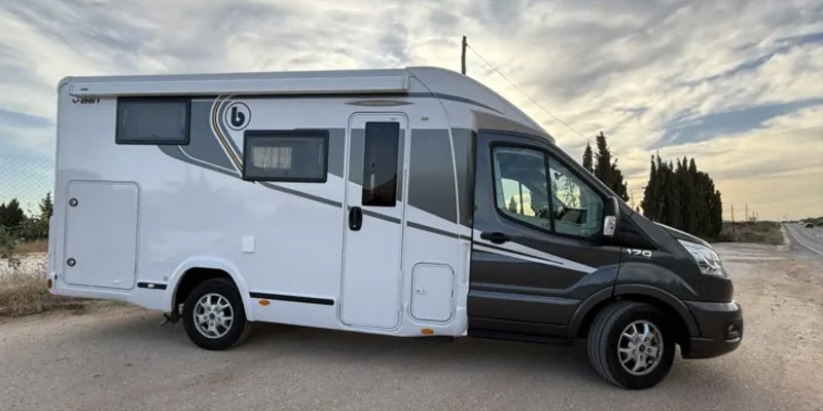
Distances are short, so there is time to stop every day, and the evenings are long and warm enough to write outside. If you want to see what kind of vehicle would suit you, from compact vans for two to larger motorhomes for families, you can browse thesecampervans and motorhomes in Alicante to compare layouts, beds and equipment before you decide.
Start with one page
The hardest part of keeping a travel journal is the first entry. The trick is to keep it small: one page a day, no more. Some days it will be three lines. Other days you'll fill two pages without noticing.
At the end of the trip you'll have something no phone can give you: a record of the journey in your own hand, with every hurried letter and every coffee stain in it. And in ten years, that notebook will be the first thing you reach for when someone asks, 'What was that trip like?'