
Introduction
If you've ever shipped a feature that depends on a generative AI API, you already know the question that keeps coming back at every planning meeting: how much is this actually going to cost us at scale? The model quality debate is mostly settled — there are several genuinely great image and text models on the market — but the pricing layer underneath them varies wildly, and it's where most AI budgets quietly hemorrhage.
This review takes a close look atApiPass, an AI API aggregator built around a prepaid credit system, and benchmarks it against Google's official Nano Banana 2 rates. The goal isn't to crown a winner in the abstract — it's to put real numbers next to each other so you can decide whether ApiPass is actually worth migrating to.
How ApiPass Pricing Works
Most AI tools in 2026 are priced one of two ways: a fixed monthly subscription with a credit quota that resets (and disappears) every billing cycle, or per-token direct billing through a provider like OpenAI or Google. Both have well-known failure modes — wasted unused credits in the first case, full retail pricing in the second.
ApiPass takes a third path: a prepaid credit balance with no expiration and no subscription floor.
Here's how the math works in practice:
- You purchase a credit package — for example, 275,000 credits for $1,250, which works out to roughly $0.004545 per credit.
- Each API call deducts a specific number of credits based on the model and the request (e.g., resolution, length).
- Credits don't reset, don't expire, and aren't tied to a monthly renewal cycle.
- There's no minimum spend, no seat license, and no overage tier to worry about.
The structural advantage here is straightforward: you only pay for what you actually consume, and unused balance sits in your account until you decide to spend it. For a business with spiky or seasonal AI workloads — marketing campaigns, product launches, batch generation jobs — this avoids the classic subscription trap of paying for capacity that goes unused.
It also flattens procurement complexity. Instead of negotiating separate billing relationships with multiple model providers, you maintain one ApiPass balance that draws against many models routed through the same API surface.
Getting Started with ApiPass: Free Trial Credits
A common friction point in adopting any AI API is the "will this even work for my use case?" problem. Docs only get you so far — at some point you need to actually hit the endpoint and inspect the output.
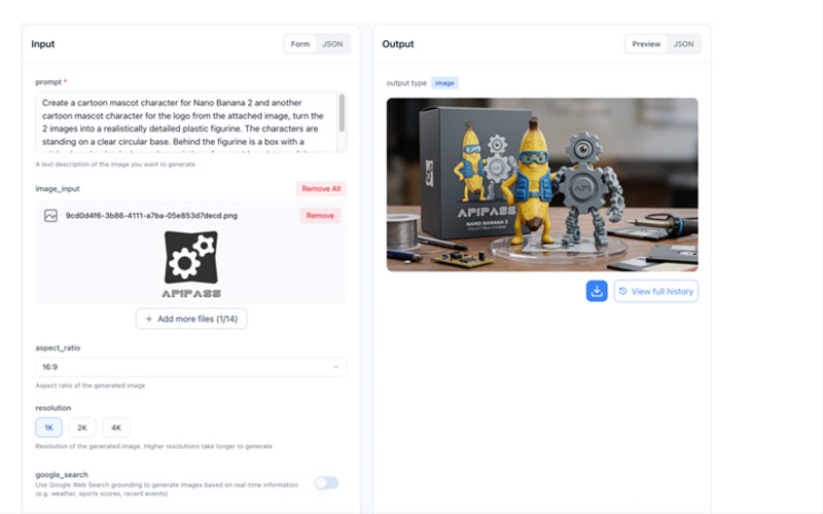
ApiPass addresses this with free credits on registration plus an interactive playground in the dashboard. The playground lets you test multiple AI models side by side without writing integration code, inspect raw outputs, tweak parameters, and estimate per-request costs before committing to production.
For a startup deciding between candidate models, this means you can prototype against Nano Banana 2 in the morning, switch to a competitor's model in the afternoon, and have a real cost/quality comparison by end of day — all without burning real dollars on evaluation. For larger teams, it's a way to let engineers vet models against actual product requirements before any procurement conversation happens.
This kind of low-friction onboarding sounds small, but it materially changes the decision dynamic. The hardest question in AI tooling adoption — "is it worth the integration effort to find out?" — gets answered for free, in under an hour.
Nano Banana 2 on ApiPass vs. Google Official Pricing
This is the section that matters most, so let's put the numbers on the table directly.
ApiPass's Nano Banana 2 Pricing
TheNano Banana 2 API on ApiPass, using the Starter channel:
Resolution | Credits per Run | Price per Image |
1K Image | 3 credits | $0.0136 |
2K Image | 5 credits | $0.0227 |
4K Image | 7 credits | $0.0318 |
Google's Official Nano Banana 2 Pricing
Based on Google's official billing disclosure, the token-based pricing for Nano Banana 2 converts to:
Resolution | Official Billing | Effective Price per Image |
1K (1024×1024) | 1,120 tokens / image | $0.134 |
2K (up to 2048×2048) | 1,120 tokens / image | $0.134 |
4K (up to 4096×4096) | 2,000 tokens / image | $0.24 |
ApiPass vs. Google: Side-by-Side Comparison
Resolution | ApiPass | Google Official | Savings per Image | % Cheaper |
1K | $0.0136 | $0.134 | $0.1204 | ~90% |
2K | $0.0227 | $0.134 | $0.1113 | ~83% |
4K | $0.0318 | $0.24 | $0.2082 | ~87% |
This isn't a 5–10% discount that gets eroded by latency or routing overhead. It's roughly an order-of-magnitude reduction for the same model output — and at every resolution tier, not just at the entry level.
ApiPass at Enterprise Scale
The savings story gets dramatically more compelling as volume increases, because ApiPass pricing scales linearly while the absolute dollar gap widens.
For an enterprise pipeline producing 1 million 1K images per month:
- ApiPass: $13,600/month → Google official: $134,000/month → Annual savings: ~$1,444,800
For 1 million 4K images per month:
- ApiPass: $31,800/month → Google official: $240,000/month → Annual savings: ~$2,498,400
These aren't theoretical numbers. They're the kind of figures that justify entire engineering hires, fund downstream product investments, or move an AI initiative from "promising experiment we can't afford to scale" to "deployed across every product surface."
And critically, none of this requires changing the underlying model. You're not switching to a cheaper, lower-quality alternative — you're calling the same Nano Banana 2 through ApiPass's billing layer. The model output is identical; only the invoice changes.
For a CFO or VP of Engineering trying to model AI infrastructure costs over the next 12–24 months, that distinction matters. Most cost-reduction strategies in AI involve trade-offs: smaller models, distilled variants, aggressive caching. ApiPass doesn't.
Does ApiPass Compromise on Quality?
When something looks 80–90% cheaper, the natural assumption is that there's a hidden cost — degraded output, downscaled resolution, watermarking, slower latency, or some kind of "lite" model behind the scenes.
In ApiPass's case, the architecture is straightforward: requests are routed to the official Nano Banana 2 endpoint, and the lower pricing is made possible by aggregated demand across many customers and many models. There's no fine-tuning layer in between, no quality compression, and no proprietary detour to a weaker model. This means:
- Identical pixel output to what you'd get hitting Google's endpoint directly.
- No output restrictions on resolution, prompt complexity, or generation behavior.
- Latency overhead measured in tens of milliseconds — negligible against the inference time that dominates image generation workloads.
The fairness of this comparison rests on that fact. ApiPass isn't competing with Google on model quality; it's competing on the billing layer. The model itself is the same one Google ships.
ApiPass Pricing Verdict: Who Should Actually Use It?
After working through the numbers, the conclusion is hard to argue with.
For startups and indie developers, ApiPass is essentially a no-brainer. Free trial credits remove evaluation risk, the prepaid credit model means no fixed cost base eating into runway, and 80–90% savings on Nano Banana 2 let you ship features that wouldn't pencil out at official rates. If you're early enough that AI cost is a meaningful line item, ApiPass is one of the easiest cost optimizations available.
For mid-market companies, the calculus shifts from "should we try ApiPass" to "why aren't we already using it." A team spending $5,000–$10,000/month on direct Google API calls is leaving five-figure monthly savings on the table — and avoiding the "credits expire monthly" trap that bundled subscription plans impose. The integration cost is typically a half-day of engineering time; the payback is usually inside the first billing cycle.
For enterprises, ApiPass savings cross into seven-figure annual territory. A multi-million-dollar annual reduction with zero quality impact is the kind of efficiency win that gets quarterly business reviews to applaud — and the kind of structural cost advantage that compounds over the lifetime of an AI product line.
Final Take on ApiPass
ApiPass delivers what most "cheaper API" promises fail to: identical model output, transparent unit pricing, no monthly credit expiration, and savings large enough to actually change product decisions. The credit system is clean, the playground lowers evaluation friction to near zero, and the Nano Banana 2 pricing is so far below Google's official rate that the only reason to stay on the direct endpoint is institutional inertia.
If you're spending real money on AI image generation today, the cost of not evaluating ApiPass is almost certainly higher than the cost of a half-day integration test. For most teams in 2026, ApiPass isn't just worth it — it's the most rational billing layer available for the way AI workloads actually grow.